
Research
How cells decide where a reaction happens
Three connected lines of work: how enzymes are organized, how organelles differ from one another, and the methods that let us see both at once.
Overview
Metabolism has an address
Three questions run through everything we do:
- 01What determines which branch a metabolite takes at a pathway junction?
- 02Are all organelles of one type metabolically equivalent, or are there distinct subpopulations?
- 03How quickly can a cell re-organize its metabolism when demand changes?
Cells rely on metabolism to generate the energy and molecular building blocks required for growth, differentiation, and survival. Textbooks present those reactions as a diffusion-driven network — substrate meets enzyme by chance. But diffusion alone does not explain how a cell keeps dozens of competing pathways running at the right rate, in the right place, at the right moment.
We think a large part of the answer is spatial. Enzymes cluster into higher-order assemblies; organelles form transient contacts and exchange metabolites across them; membranes create local pools where concentrations look nothing like the cytosolic average. Position, in other words, is a form of regulation.
Theme 01
Enzyme-level compartmentalization
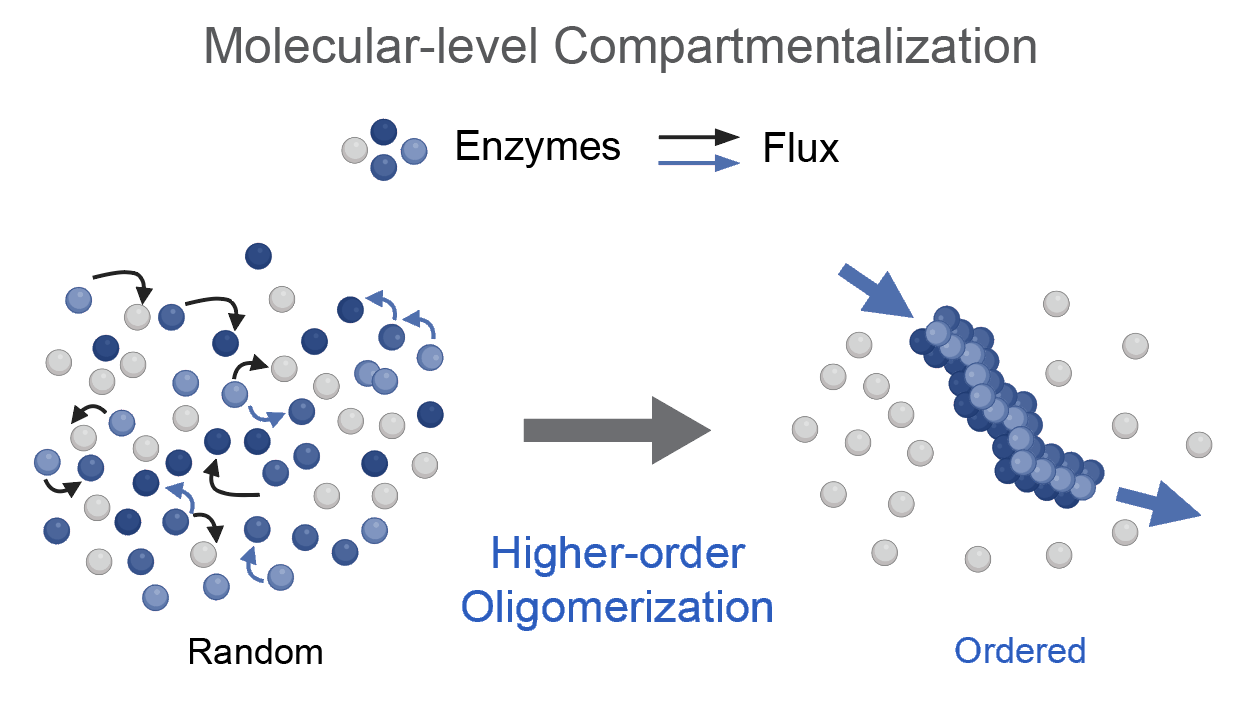
Many metabolic pathways contain branch points where a metabolite can be pushed into competing reactions, but how cells control flux through those branch points is poorly understood. We investigate how enzymes are spatially organized through higher-order assemblies and dynamic associations, and how that organization sets pathway choice and metabolic efficiency.
Theme 02
Organelle-level compartmentalization
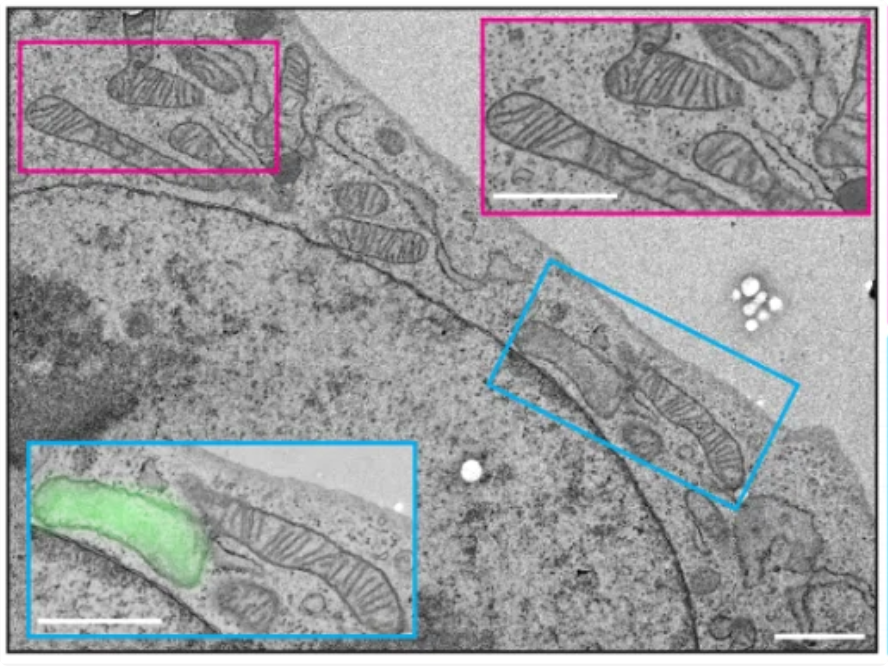
Organelles were long viewed as isolated, static units, but they are highly dynamic and in constant communication. We ask how organelle dynamics and inter-organelle contacts shape metabolism: whether distinct metabolic subpopulations exist, and how that heterogeneity feeds back on pathway regulation and cell function.
Theme 03
Approaches we use
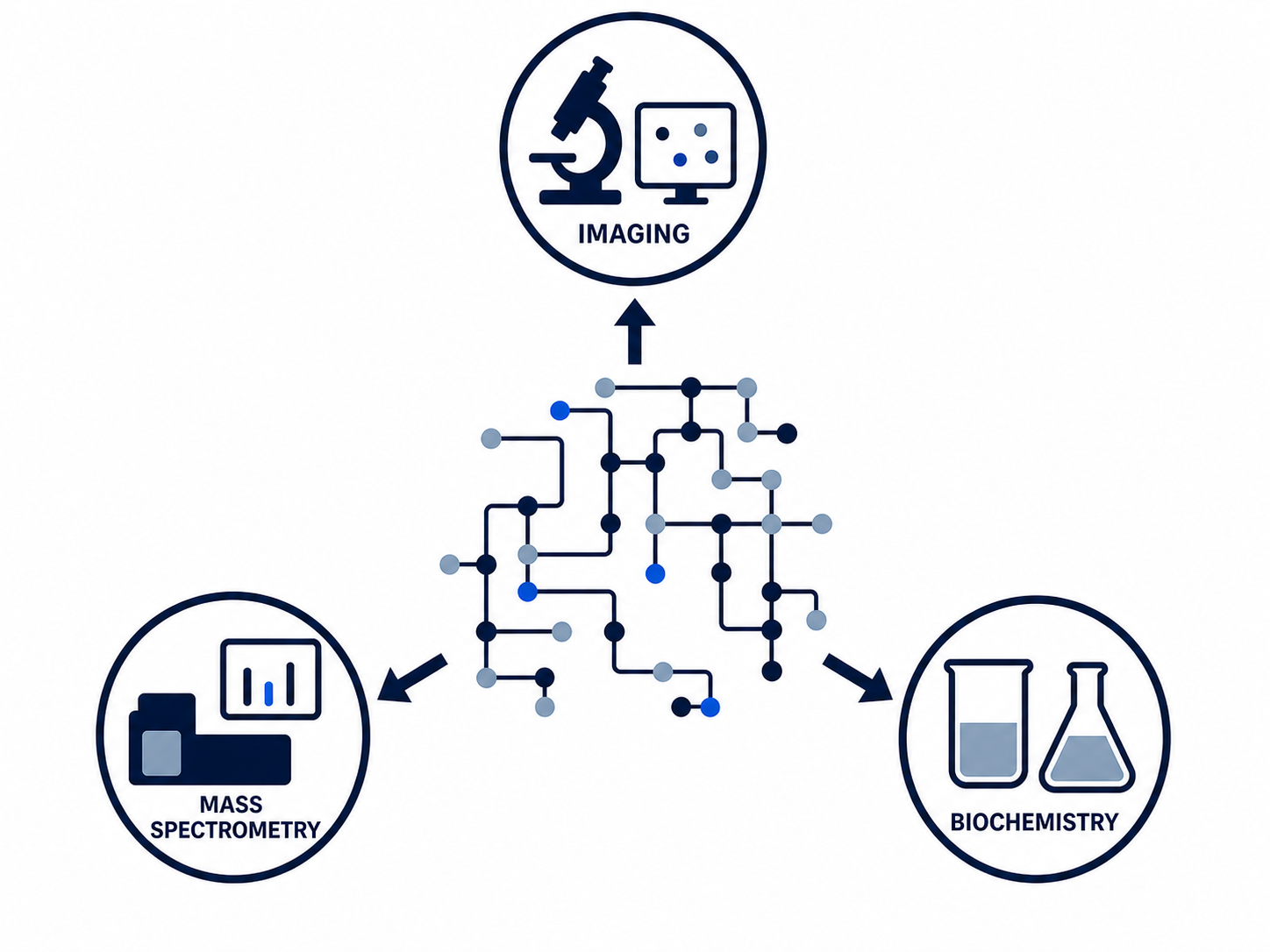
We integrate cell biology, biochemistry, and metabolism — pairing imaging that resolves where a reaction happens with measurements of what the reaction produces.
- —Super-resolution fluorescence and live-cell imaging
- —Advanced electron microscopy (FIB-SEM, CLEM)
- —Metabolomics and isotope tracing
- —Biochemical reconstitution and enzyme assays
- —Genomic and CRISPR-based perturbations
Work with us